I was going to tell you all about the time when my family was sitting at the kitchen table at lunchtime, and we heard someone fall down the staircase, hit the wall, and land in the vestibule right by the front door. We searched the house inside and out, didn't find a person nor a tree limb nor anything else that could have made the whole house shake as it did. But that's all the story there's to tell and though it was frightening to me at the time, in retrospect, it's just another spook story.
Instead I have been compelled to tell you about a different kind of ghost story. It's about the ghosts that lurk quietly, not to scare us, but, perhaps to watch us and help us not to get into any more trouble than we already get into all by our lonesomes.
For instance, when in the late 90's my sister called me from Italy to tell me that my grandmother had passed away, I already knew. That night I had been sleeping soundly, when something in my dream shifted abruptly. I felt my grandmother entering my dream with such vividness that the emotion I felt in seeing her sucked me awake. I asked my sister what time my grandmother had passed away, but even before she confirmed my suspicions, I already knew.
She visited a couple of times since then, too. I cannot mistake the smell of my dear grandmother, that mix between cigarette smoke and chef's soap. When she's around, I say hello to her in my head. I imagine she's always surprised that I know she's come.
I've also had some other lucky visitations. The most vivid of them was when I was 8 or 9 years old and I'd gotten lost on a mountaintop during a snow storm during ski camp. The lifts had closed down but my brother and I had got stuck on the top of the mountain, and there was no way to get to safety but on skis. An instructor had tried to help us out, but my brother was so small that the wind kept sucking him up, so the instructor tucked him between his legs and propped him on top of his own skies. That was enough of a balancing act that he didn't look back to see if I was following, and he didn't notice that, though I was bigger than my brother, the wind was slowing me down. Pretty soon my brother and the man disappeared into the mist and snow, out of my sight, and shortly after that, their voices were too faint to hear. There was nothing but ravines around me and trees ahead of me. I didn't know the way.
I was talking to myself, saying something like, "God, I'm going to die," mewling and thinking of all the stuff I'd seen on the news of people getting lost on mountains and freezing to death, when I heard a calm, friendly voice behind me, a man who asked me if I needed help. I was a little embarrassed to have been caught talking to myself and I barely nodded. He told me to take off my goggles and slipped them in the pocket of his ski jacket, but I never actually saw this man above the waist. I never looked up to see his face. He led me down the mountain and shielded me from the strong gusts of wind, and when we got down to the shelter he helped me take off my skies, then asked me if I wanted some hot chocolate. Still without looking at him I nodded yes. He led me inside the chateau and stepped into the crowd.
The moment he did, I heard my father's voice behind me: "Where have you been?"
I told my father everything.
"Where are your googles?" my father wanted to know.
I pointed to the crowd where I thought I might recognize the man who had gone to buy me a cup of hot chocolate, who still had my ski googles in his pocket, but I realized I didn't know him. He could have been anyone. We waited and waited, but the man never came back.
Was he a ghost? A dream? An angel?
Does it matter?
One time as I was driving on a highway towards work, I got sandwiched between a slow truck before me and a car speeding fast into the highway from a ramp to my right. With no time to step on the breaks I had to cut off a woman in a corvette on my left lane. I then slipped back into the right lane to give the corvette room to pass me, but the corvette had also slipped back to the right lane, and seeing me maneuver like that, the woman driving the corvette leaned heavily on the horn. She passed me to my left, but not content, she slowed down so that we traveled at the same speed. She leaned on the horn again, staring at me and cursing me out. I flipped her the bird. I saw her gape at me. I saw the look that came over her face with her unsavory decision. I saw her spin the steering wheel, her lips between her teeth, obviously intent on slamming her corvette into my station wagon. I saw the hood of her car nearing towards mine.
This is the part I still don't understand. Her car didn't hit me. Her car swerved as if pushed away by an invisible forced and did a 360 on the highway. I barely swished by and saw the corvette spinning in the rearview. Luckily she did not crash, nor did anyone behind her on that busy highway. Something similar happened a few years later when I was stopped at a light and an out-of-control car screeched and careered towards me only to swerve on a split second, again as if by pushed away by some invisible force.
And this ghost visitation seems to be a family matter. When my sister was a baby, my mother woke up from her crying. Slow to respond she was surprised that before she got to the baby's room, the baby had stopped crying already. She peeked softly into the baby's room, careful not to make noise. A woman in a WWII nursing uniform was bent over the cradle -- or so it seemed in the shadows. My mother asked, "Who is that?" but there was already only just darkness. Another time, during a particularly trying night, my mother saw and heard her father call her name: he was dead then already twenty years. He was an illusion of light, a whisper of the wind, but he had enough substance to say her name, to ask what is the matter, in a loving enough voice that my mother jolted out of her sadness and into wonderment.
Yesterday, I was working on an email in response to something my sister had sent me that had made me angry. Needless to say, what I was writing wasn't kind. When I hit the send button, however, my gmail said "There is a problem with the server. Please try again later." The thought hit me that it might have been a sign not to engage in an argument with my sister, but I hit send again. And again a few moments later. Still, the email wouldn't go through.
To appease my guilt, I began to edit the email down. For every paragraph that I edited or cut, I hit send, and still the same error message came back. I checked my internet connection. It was working. I checked FB. It was working. I tried to send my message again and still the same server error popped up. This went on for a while. I went on FB and asked if anyone else was having problems with gmail. Nobody else seemed to be having problems.
Finally, my better wisdom prevailed and I deleted the email to my sister. Within a few seconds, I was able to send and receive email again.
Was it a ghost or an angel or just coincidence?
I don't know, but I did remembered then that Halloween is, after all, not just about ghosts and monsters. It's also about remembering those who passed away, and about honoring the "hallowed" saints who look over us from that world beyond.
So it occurs to me that the dead want to be remembered, not just as spooks and apparitions, but also for their best hopes for us.
It reminds me of one of my favorite poems by Susan Mitchell, The Dead, from which I will quote only a few lines out of respect for copyright:
Some dead find their way to our houses.
They go up to the attics.
They read the letters they sent us, insatiable
for signs of their love.
So on this All Hallows' Eve I'd like to express my gratitude for those who watch over us, and also offer a little prayer for our ancestors: that they may thrive in peace, love and joy, wherever they may be.
______________
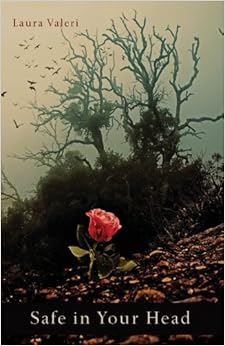
Laura Valeri is the author of Safe in Your Head, which has ghost stories in it, and the author of The Kind of Things Saints Do.