Tuesday, May 28, 2013

Tina's Review of Maleficae by Emma Bolden


It’s a title that reeks of infamy — the Malleus Maleficarum, Hammer of the Witches, a fifteenth-century guide to the persecution of witches written under the cloak of religious piety. I cannot hear or see those Latin words without recalling my knowledge of the historical Burning Times, without tasting ashes in my mouth. Unfortunately, the persecution still exists — there are still fires aplenty in this world for those deemed different, subversive, dangerous, and demonic. Now, as then, most of the victims are still women.
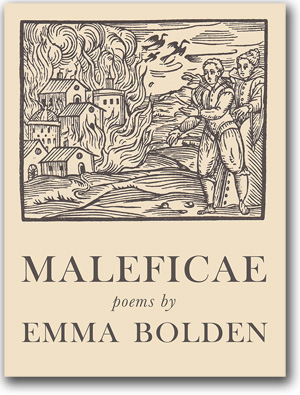
            I knew these things when I first learned about Maleficae, Emma Bolden’s collection of poems relating this inhumanity by telling the story of one witch. I knew there would be torture, flames and death, and I wasn’t sure I could bear to open such a book. However, I am grateful that I did, grateful that my first introduction to the poems came on a stage here in South Georgia, when I heard Bolden read from Maleficae. These intensely personal, painfully lyrical poems shattered the distance between me and the anonymous witch whose voice is heard throughout. They sing and sting, indict and provoke. They are woven with the threads of life and death and rebirth, power in all its manifestations, survival in the face of extinction. Together, they create a human story made intimate through the voices and visions contained within, especially the narrative of the witch herself.
            The words are evocative and often beautiful, the imagery visceral, precise, wrenching, vivid. Bolden’s carefully spaced words and phrases feel organic. They deliver so much gratification on first read that one can’t help returning to the lines again and again. It’s only on that second or third pass that the deeper meanings bloom, as in this, the beginning of “The Witch Remembers Her Early Learnings”:

When I learned     to speak     I learned
to speak in     rushes     entwining
their arms     to wind     down the river     which always wanted
to escape its stays

Bolden respects the powers of visualization. She provides the necessary sensory details, the one-two-punches of metaphor and description, and the reader constructs the whole of the scene — the low-lit barn, the lovers in bed, the circle cast in the oaks. Or here, from “The Witch Remembers Her Body as Holding,” the transformational agony of childbirth:

I became
animal     pressure     pain     howl
of wolf packs     and     women split
by the same     shriek    the same muscles
snapped     we are all     unmade     by making

Though the rhythm feels easy, these are finely wrought, carefully honed pieces. Their seamlessness is seductive, and treacherous.  When I followed their heartbeat cadences, they led me straight into the noose. Watch what Bolden does in this stanza, from “The Liturgy of the Word”:

she who with hair sun-slick even in moonfall     a woman
of ribbons     who glistens     sent by God
and His Good Grace     to punish     to warn the other good
women of what good     can do

The repetition of the word “good” at first feels beneficent, coming as it does after the description of the glory of a beautiful, nature-graced woman, a woman of God. Then that sharp infinitive — “to punish” — and the trap is set and sprung.
            The witch of these poems is an herbalist and midwife, healer and medicine worker. In her everyday labors, she makes the hard choices for the village, and they let her.  Her hands bring both life and death, sometimes intertwined so tightly that they cannot be separated. In one poem, the villagers express how they see her, what they think she can bring them — “tables stacked high with fattened fowl and flock” —  but on a deeper level, the most important thing she delivers is a sense of control to their lives, which are often harsh and filled with arbitrary tragedy.
            This power she possesses is dangerous, but in the eyes of her eventual accusers, the first and most damning of the evidence against her is her gender. Women were considered the inferior sex, and as such, more susceptible to Satan’s wiles. In the textual notes, Bolden quotes from Malleus Maleficarum: “And it should be noted that there was a defect in the formation of the 1st woman, since she was formed from a bent rib . . . . And since through this defect she is an imperfect animal, she always deceives.”
            Bolden echoes this belief in several of the poems, with lines such as “An unwatched woman is a waiting calamity,” and “Adam’s rib bent eternal/struck straight only by a man’s guidance.” Most powerful to me is this stanza, at the end of “The Witch’s Apprenticeship,” a poem detailing the witch’s delivery of an out-of-wedlock baby, an event that ends with the death of the mother:

this is the hemorrhage     that can’t
be contained     this is the woman     now a body
unholy     by priest forbidden     from churchyard     this is the salt
you’ll let fall     in blessing     her new-mounded grave

The poems are rich with the tangible details of this nameless witch’s ancient craft— the herbs with their powers both mundane and magical, the charms and candles, the spells and petitions — and with the spiritual vocabulary that the witch uses to describe her God. She uses the word in its masculine sense, but her God is very different from the God of the Christian priests. In the poem, “The Witch’s Testimony Hour Seventy-Two: In Which the Witch Describeth Her God,” she gives voice to her understanding of the Divine in a fevered spill of torture-induced words that are nonetheless an evocation of the Sacred Masculine:

the wolf ’s hair standing guard against rain the rain
that slides from the wolf ’s slate coat the forest marten furred
in darkness the darkness itself and the light lying within its
sealed lips

In response to the accusations against her, the witch says, “yes I understand the severity of charges, I understand of all things severity.” My heart cracked at those words. I had heard this woman’s stories, glimpsed her life. The connection between us had been forged, an impossible connection that was nonetheless true and real.
            Even though I am quoting from these poems, I am leaving some of the more breathtaking phrases between the pages of the book, to be discovered there. The experience of seeing the poems on the page invites new meaning with each reading — the spaces and pauses open up new interpretations, sometimes twisting the reader around mid-line. We know how this story will end, for we know our history; we know the hundreds of thousands of endings recorded throughout Western Europe for centuries. Despite our knowing, the poems still startle. Consider, for example, “The Witch’s Daughter Still Lives,” narrated by the witch’s young child, a witness to her mother’s execution, which becomes in her eyes an alchemical transformation:

that morning
with my new mother
I said the fire
was an angel     I said
it was the story of burning
straw into gold and the sparks
were spirits   I said someone

was making gold

One thing I especially appreciate about this collection is that Bolden included explanatory textual notes, as well as a listing of her resources (which included everything from the Malleus Maleficarium itself to Stephen Wilson’s Magical Universe: Everyday Ritual and Magic in Pre-Modern Europe). While I recognized many of the herbal and magical items, there were many references unfamiliar to me, especially in this historical context. I learned a great deal, but because Bolden saved these explanations for the end instead of using footnotes, the poems themselves weren’t interrupted by pieces of documentation.
            Bolden ends the collection with a simple dedication: “Finally, for the witches — Requiem æternam dona eis, Domine, et lux perpetua luceat eis.” From Mozart’s Requiem, the words can be translated as, “Grant them eternal rest, O Lord, and may everlasting light shine upon them.” Bolden’s poems illuminate too. They cast light on a terrible subject, creating new shapes, new shadows. While the darkness she conjures may be deep and painful, readers should not fear these poems, heartbreaking and soul-rending though they may be. Come to Maleficae as you would to the point of the sword, with perfect love and perfect trust in your heart. You will be rewarded.
*         *          * 
You can get a copy of  Maleficae straight from the publisher GenPop Books or find it on Amazon.com or -- and you should do this if you possibly can -- from Emma Bolden herself.  Learn more about Emma at her website: http://emmabolden.com/

Monday, February 4, 2013

Tenth of December: George Saunders' Vision of the Future

If you haven't yet picked up this book, do it.  If you're a writer and you haven't yet picked up this book, really do it.  If you're a writer who reads and writes fiction and you haven't yet picked up this book: you'll be missing out if you don't read this book.

Some of the stories in Tenth of December remind me a little bit of of Kurt Vonnegut, pointing towards the absurd dilemmas of a technologically driven society.  In "Escape From Spiderhead" a convict is a lab rat for a commercial pharmaceutical company that tests emotion enhancement drugs. "In The Sempica Girls Diary" a middle class father trying to make his children happy buys into a dehumanizing practice that victimizes illegal immigrants.  And in "My Chivalrous Fiasco" an employee of a Medieval themed entertainment facility is bribed to silence by way of a mind-enhancing "upgrade" to a Pacing Guard position in the live and interactive Medieval tech show.

Saunders' terrifying scenarios are populated by glib, self-justifying morons but the stories crackle with wit.  In "My Chivalric Fiasco" the medical enhancement KnightLyfe is designed to gift its patient with verbal abilities presumedly realistic to medieval speech:  "What ho! Had charged. Up crude ladders, with manly Imprecations." (I still laugh when I read that one).  When the recently returned veteran in "Home" returns to his own haunts he walks into a store, but isn't sure if it is a store because he can't tell what they're selling.  The MiiVOXmax that he picks up looks like a tag rather than a product. When he asks what the product is, the retail clerk responds, "It's more like what it is for, is how I'd say it."  Naturally the veteran asks what it is for, the clerk replies "this is probably more the one for you," and offers him an identical item called a MiiVOXmin, and its purpose is equally obscure.

There wasn't a single story in this collection that I didn't simply devour.  In spite of the frustrating and often tragic events, the characters are each so well-intentioned, so hopeful and so full of heart that it's hard to come out of reading even the most pessimistic of these stories without coming out at the end of it with a sense of optimism for the future and elation for the general good heartedness of people.  In "Tenth of December," the collection's title story, a cancer patient resolves on committing suicide, but ends up instead involved in a rescue situation.  In "The Semplica Girls Diaries" the middel aged disgruntled father desiring status and money throws it all away without a blink to protect his children.  In "Escape from Spiderhead" it's the life-sentence convict who is able to make the most moral and the most selfless act.

These beautiful stories each glow with Saunder's imagination, his vision of a world ruled by an insensitive money-driven society tempered by the tender and altruistic instincts of its most ordinary citizens.  Every story leaves us with the sense that human nature itself has been redeemed, its thoughtless ambition in the end always overwhelmed by the simple need to connect to our loved ones, and to do what's best for others, in spite of ourselves.

Sunday, January 27, 2013

Mojito Literary Society Writers Retreat WInter 2013


What are the ingredients of a top-notch writers retreat, you ask? First, start with three writers (more or less, to taste). We liked a mix of poet, historical fiction writer, and mystery novelist.

Place in secluded location (a cabin in the mountains is ideal, but beaches and some cities could be substituted -- here is the view from our front porch at Paradise Hills Resort and Spa in Blairsville, GA)
Add ice (sleet and/or snow and/or freezing rain are all acceptable forms of frozen precipitation)
Season with BACON (no substitutions)
 
Warm gently

Flavor with your favorite libation (a large and varied selection is a MUST! Quality preferred but not required.)


Write like a maniac . . . and enjoy. Here's hoping you get to join us next time.

Friday, December 14, 2012

Read It! Wrap It! Love It! -- The Cento: A Collection of Poems

I am in AWE of poets. Magicians, they are, able to distill life and experience to their often surprising essence. So maybe they're moonshiners too, stirrers of mash and sippers of elixirs. We have some poets among our Mojito sisters, so I know they'll appreciate my December must-have, and my Book Happy recommendation -- Theresa Welford's anthology The Cento: A Collection of Collage Poems.(which you can order HERE).

A cento is a poem composed entirely from lines of other works in a new form or order. It means "patchwork" in Latin, and like visual collages, it includes images reworked into a new vision. ANd this collection of cento poems apparently rocks. According to no less an authority than X.J. Kennedy, “Theresa Welford’s anthology of poems in that curious form the cento is a true labor of love. In an array of patchwork poems by poets famous and poets new, The Cento: A Collection of Collage Poems reveals both the dangers of the form (creating chaos) and its rich rewards when performed with wit and creativity on the part of the poet (as in R. S. Gwynn’s hilarious cannibalization of The Norton Anthology of Poetry). No one will supercede this achievement for a long time, I’d guess—maybe not for a hundred years.”

An excellent gift for YOUR favorite poet.


Tuesday, October 30, 2012

And the coveted Triple Mojito Salute goes to . . .


We the Mojito Literary Society are ridiculously, almost illegally, proud to share the following announcement from Publishers Marketplace:

SOLD: "Susanna Ives's WICKED LITTLE SECRETS trilogy, each featuring an aspect of Victorian society that hero and heroine defy, to Deb Werksman at Sourcebooks, by Paige Wheeler at Folio Literary Management."

In honor of her forthcoming trilogy, we are hoisting not one, not two, but THREE mojitos in her honor -- way to go!

Wednesday, September 5, 2012

Book Labyrinth Art

When I think of heaven, it looks like this -- with a comfy chair and mojito in the middle.

From a bird's eye view, visitors weave through the elaborate fingerprint shaped book labyrinth, which will be on display until Aug. 25 in the Southbank Centre, a large art space situated near the Waterloo Bridge.
Employee Tilly Shiner browses through books inside the aMAZEme labyrinth on July 31 at The Southbank Centre in London, England. Brazilian artists Marcos Saboya and Gualter Pupo used 250,000 books to create this literary maze for the London Festival, a 3-month-long cultural event held concurrently with the 2012 Olympics.

Tuesday, August 28, 2012

Review of Douglas Corleone's LAST LAWYER STANDING

Available NOW on Amazon.com
By Tina Whittle

If there’s one character I love spending time with, it’s the heroic anti-hero. Someone whose biggest triumphs come not from conquering some nefarious villain — although he does manage to get some righteous licks in — but from conquering his own tricky, confounding, paradoxical nature. To paraphrase the newest incarnation of Sherlock Holmes, just because these guys are on the side of the angels, don’t make the mistake of thinking they are angels.

Enter Kevin Corvelli, criminal defense attorney extraordinaire, hotshot protagonist of Douglas Corleone's third novel, Last Lawyer Standing. Typically fresh from some dicey shenanagin, Mr. Corvelli carries trouble in pocket. He curses, dodges, and gets knifed or hit or threatened a lot. He’s well acquainted with both pills and liquor. And he’s exactly who you’d want showing up in court for you, because whether you’re innocent or guilty, he’s there to defend you to the best of his ability.

And while one sharp attorney, he’s also a crackerjack sleuth. He has to be, especially in this, his third outing after the equally sharp One Man’s Paradise and Night on Fire, the first and second novels in this series. It’s a juggling act from the first page, and Corleone is a master at keeping those balls in the air. Judges, clients, hookers, gangsters, bad cops, good cops, assassins, politicians — they all circle like sharks as Corvelli struggles to acquit his perpetual client Turi Ahina of a murder charge while simultaneously serving as counsel to the governor of Hawaii, caught up in a scandal of mistresses, money and murder most foul. Throw in a mafia scion who needs babysitting and a gorgeous AUSA with a recent divorce, and it’s all Corvelli can do to keep the cat fed.

No fears. The cat does not go hungry. And readers will find satisfaction too. Corleone is a master plotter — the narrative never lets up, and the clues come faster than speedballs. The Hawaii that serves as a backdrop functions more as a character than setting, complete with its own tics and eccentricities — you might not want to live in Corvelli’s version of paradise, but you’ll find yourself enjoying a temporary visit with him as your guide. The voice is snarky and smart and authentic, self-aware but not the least bit self-righteous. I mean, how can you not love a character who says, “Somehow . . . I’d grown a conscience with respect to my motives in the courtroom, and it was going to kill my client. What the hell had I been thinking?”

One big theme in the Corvelli series is the moral quandary that comes from serving the ideal of truth and justice by defending the lying and guilty. Even Corvelli has his standards, and they complicate his job and his life in ways that even his clever maneuvering can’t always evade. It’s a hard profession he’s chosen — little wonder he daydreams of tending bar — but his challenges are our gain. I’ll buy a ticket to whatever ride Corleone offers as long as Kevin Corvelli is sitting in the seat next to me.

You can read more about Douglas Corleone on his website: www.douglascorleone.com.

Recommended Beverage Pairing: Anything but red wine (read the book — you'll get it). How about a nice tall beer instead, something locally brewed? A clean and hoppy IPA perhaps?

*          *          *          *          *          *          *          *          *

Tina Whittle is a mystery writer living and working in the Georgia Lowcountry. The Dangerous Edge of Things, her first novel, debuted February 2011 from Poisoned Pen Press, followed in March 2012 by Darker Than Any Shadow. Described by Publisher’s Weekly as a “tight, suspenseful debut,“ this Atlanta-based series features gun shop owner Tai Randolph and corporate security agent Trey Seaver. The third book in the series —Blood, Ash and Bone —is available now for pre-order at Amazon. Visit tinawhittle.com for more information, including a schedule of appearances.